

The treadmill
A single agent in a chat window is a black box on a treadmill: it forgets what it decided ten steps ago, stalls mid-job waiting for a nudge, and loses everything if the process crashes. The model is good; nothing underneath it is durable, so there’s no record of what finished and nothing to resume from.From chat to durable background work
Smithers moves the work off the treadmill and into a durable runtime: you describe a real job and it runs in the background. Every step is persisted the moment it finishes, so the runtime always knows what’s done and what’s next, and stays observable instead of a black box.
Smithers is the durable layer between you and the models, the part that doesn't change when the agent topology does.
You don’t write workflows. You talk to your agent.
You don’t click a GUI or write code. Install thesmithers skill into your coding agent, and you drive it through your agent. Say what you want in plain language: it picks the workflow, starts the run, watches it, and brings back the result, or pauses when it needs a decision. You stay in the chat you already use.
TSX workflows and the CLI exist to read, but the primary path is a sentence to your agent.
What you get
Four guarantees a chat-window agent can’t give you, on any agent, any model, any machine.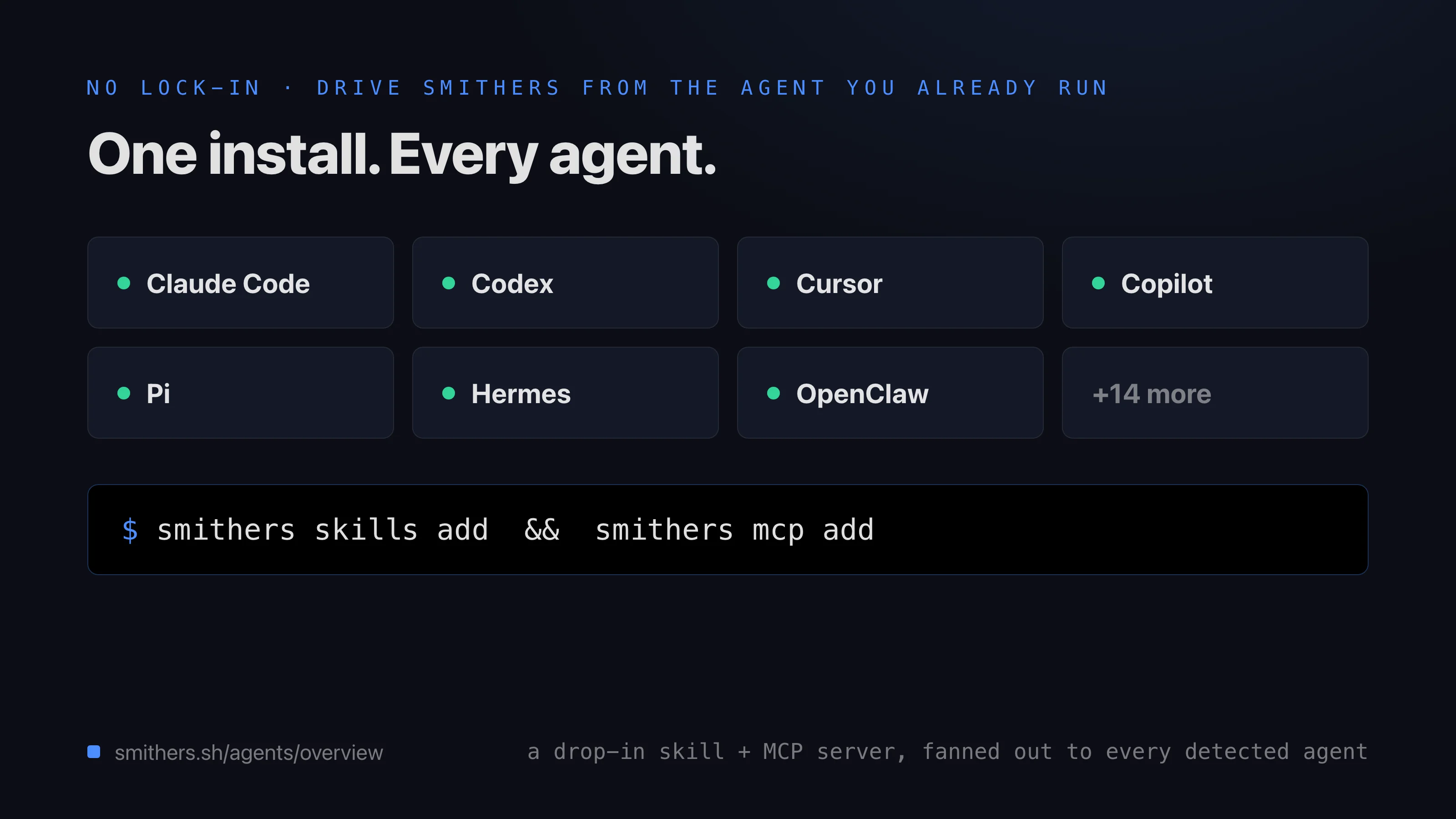
The same job runs across different agents and models without rewriting the work, proof that Smithers isn't tied to one lab or one harness.
The magic moment
Open your coding agent and say:“Add rate limiting to the API and don’t stop until it builds, validates, and the review signs off.”A durable run writes the code, runs the build and tests, loops on failures, and pauses for your sign-off once review approves.
“Keep working on reducing our flaky tests and don’t stop until I tell you to.”A long-horizon run that grinds on flaky tests in the background, surviving crashes until you call it off.
“Migrate the dashboard to the new gateway APIs. Show me the milestone plan before you start, then work through it.”Plans the migration, pauses for approval, then executes milestone by milestone, resuming exactly where it left off if interrupted.
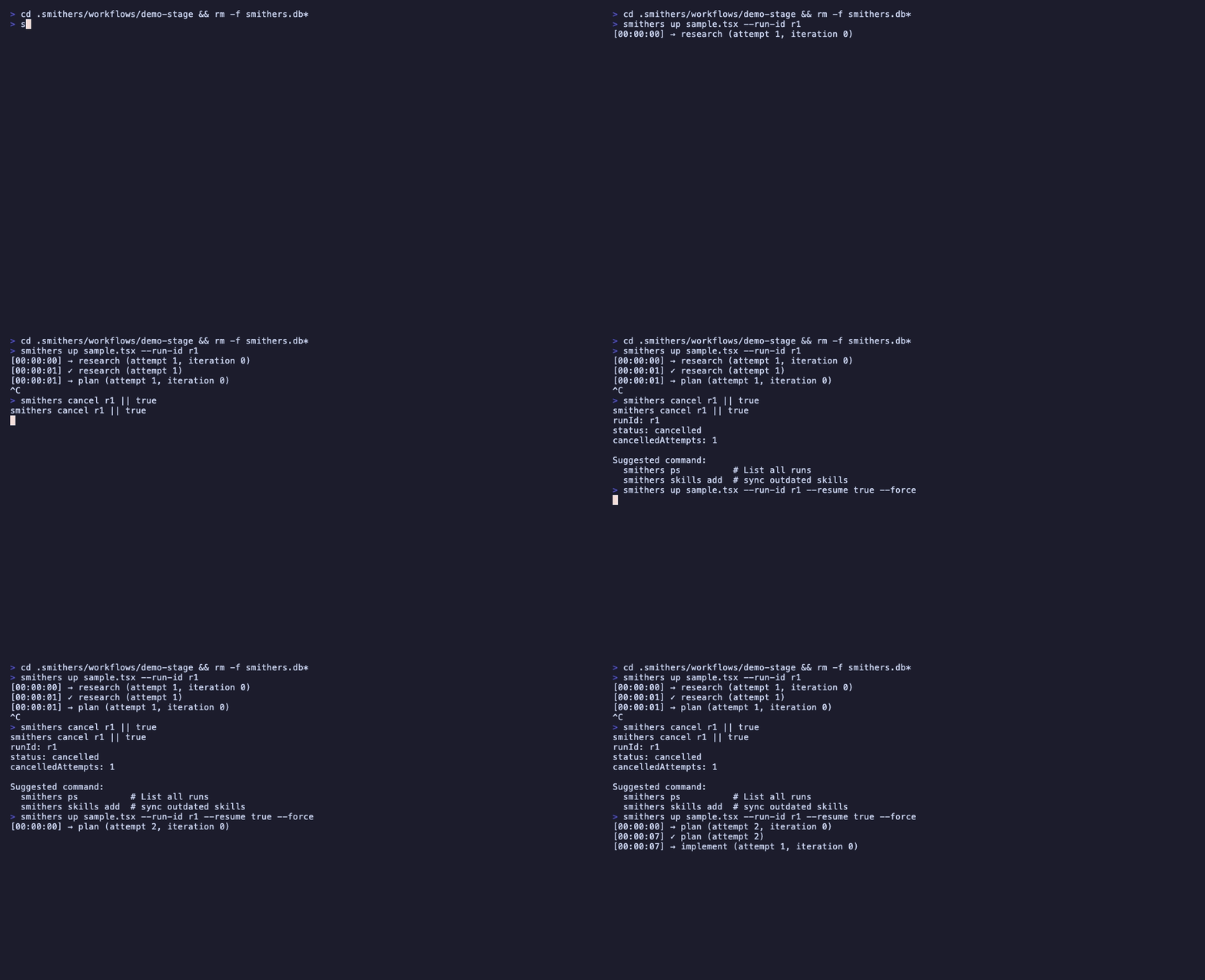
A run survives a hard crash mid-task and picks up exactly where it left off, with no lost work and no restart from scratch.
Read next
Get started
Tutorial: install the skill and run your first durable job.
What you can do
Reference: the outcome catalog of real jobs you can hand off, and what to say.
The few concepts you need
Explanation: the handful of ideas (runs, frames, approvals) behind it.