> ## Documentation Index
> Fetch the complete documentation index at: https://smithers.sh/llms.txt
> Use this file to discover all available pages before exploring further.
# tickets-create
> Break a request into multiple implementable tickets.
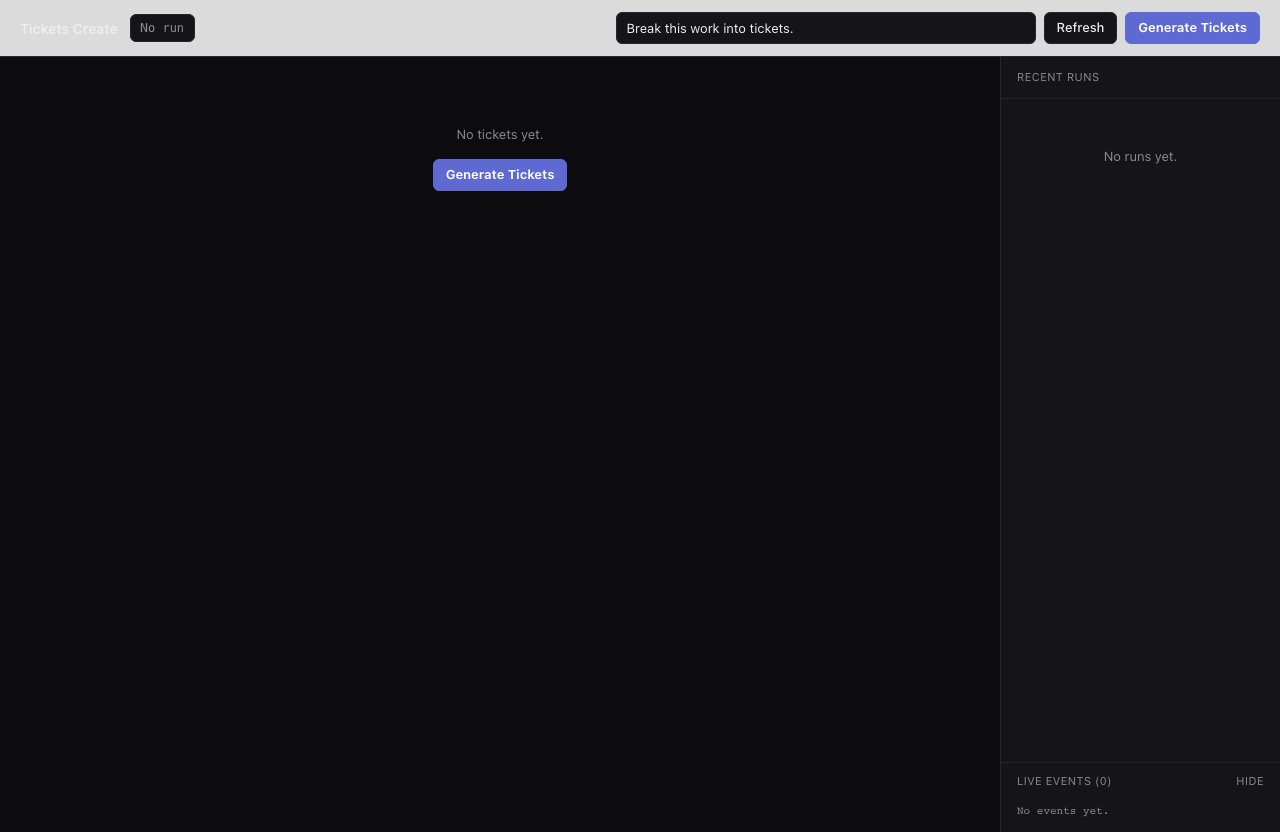
`tickets-create` is an archived example, not installed by `init`: copy it from `examples/init-pack/` with its dependency closure, or ask `create-workflow` to build an equivalent. It decomposes a broad request into a set of tickets, each with a title, description, and acceptance criteria.
```bash theme={"theme":{"light":"github-light","dark":"github-dark"}}
bunx smthrs workflow run tickets-create --prompt "Build the billing admin workflow"
```
 ## Inputs
| Input | Type | Default |
| -------- | ------ | ------------------------------------------ |
| `prompt` | string | `"Create tickets for the requested work."` |
## Typical Flow
1. Run `research` or `grill-me` for context.
2. Run `tickets-create` to split the work.
3. Copy the generated ticket Markdown into `.smithers/tickets/` before running `kanban`.
4. Run [`kanban`](/workflows/kanban) to implement them in parallel worktrees.
## Use it when
* A request is broad enough to split into several implementable tickets.
## Use something else when
* The request is one narrow unit: use [`ticket-create`](/workflows/ticket-create).
* Requirements are still vague: run [`grill-me`](/workflows/grill-me) or [`research`](/workflows/research) first.
## Resume & retry
`tickets-create` returns ticket Markdown in the run output. Runs are durable and resume with `up --resume`.
## Inputs
| Input | Type | Default |
| -------- | ------ | ------------------------------------------ |
| `prompt` | string | `"Create tickets for the requested work."` |
## Typical Flow
1. Run `research` or `grill-me` for context.
2. Run `tickets-create` to split the work.
3. Copy the generated ticket Markdown into `.smithers/tickets/` before running `kanban`.
4. Run [`kanban`](/workflows/kanban) to implement them in parallel worktrees.
## Use it when
* A request is broad enough to split into several implementable tickets.
## Use something else when
* The request is one narrow unit: use [`ticket-create`](/workflows/ticket-create).
* Requirements are still vague: run [`grill-me`](/workflows/grill-me) or [`research`](/workflows/research) first.
## Resume & retry
`tickets-create` returns ticket Markdown in the run output. Runs are durable and resume with `up --resume`.