> ## Documentation Index
> Fetch the complete documentation index at: https://smithers.sh/llms.txt
> Use this file to discover all available pages before exploring further.
# 0.31.0
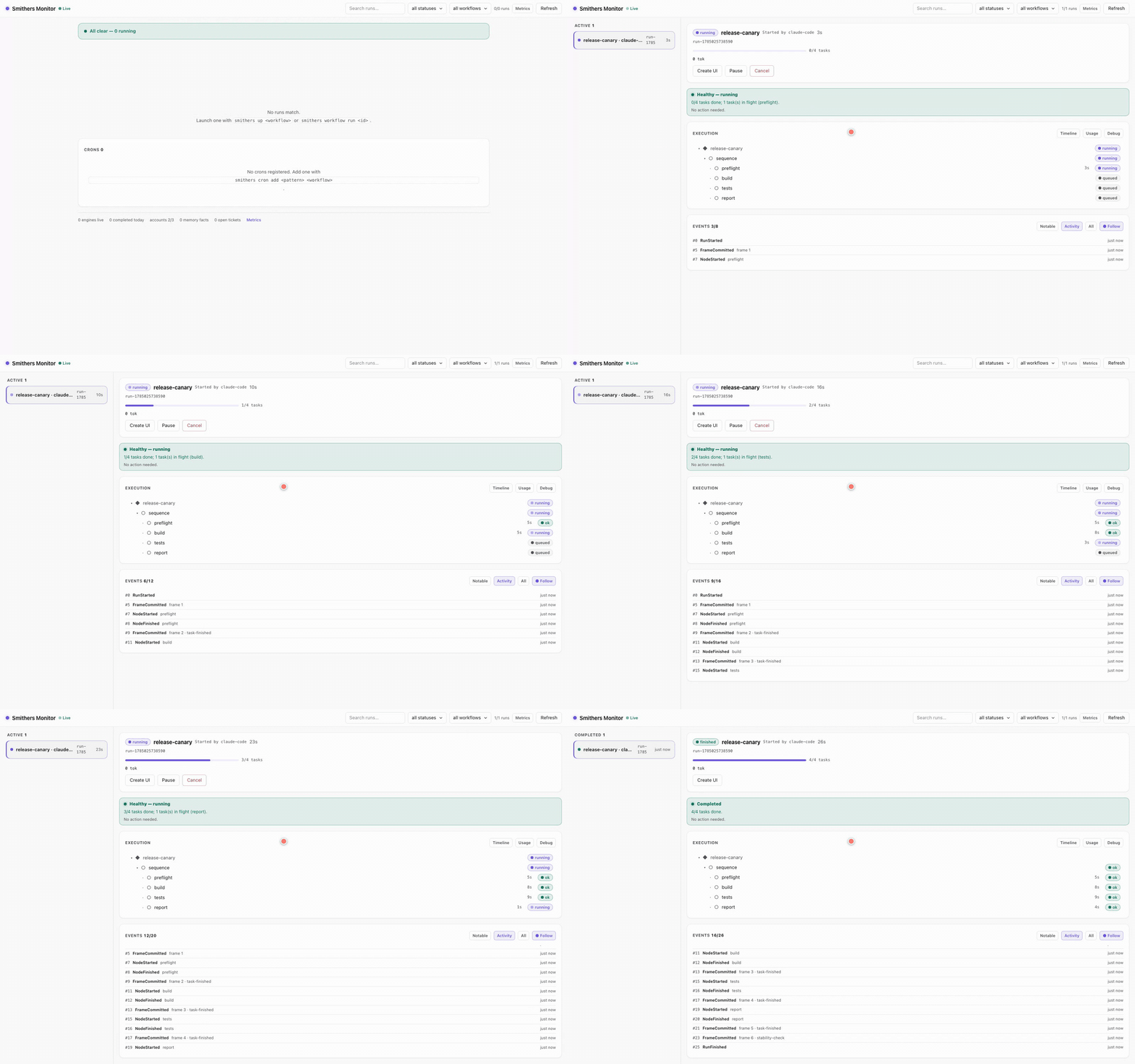
> Smithers 0.31.0 lets you mark task and tool side effects with revert handlers so rewind, fork, and replay compensate or block instead of silently re-firing real-world actions, and makes Claude Opus 5 the default implementer and orchestrator.
Smithers 0.31.0 makes time travel side-effect-safe. Rewind, fork, and
replay have always restored run state and worktree files, but they knew
nothing about what a run did to the outside world: rewinding past a task
that posted a message left the message up, and replaying posted it again.
Now you mark those actions, Smithers journals them durably, and every
time-travel operation compensates for them, blocks, or reports exactly
what it crossed. Claude Opus 5 also takes the default implementer, smart,
and orchestrator seats in the model registry.
 ## Upgrading
```bash theme={"theme":{"light":"github-light","dark":"github-dark"}}
bunx smithers-orchestrator update # upgrade the CLI
bunx smithers-orchestrator upgrade # agent-assisted: reads the changelogs and applies what your project needs
bunx smithers-orchestrator packs update # refresh installed workflow packs
```
Behavior changes are collected in the [upgrade notes](#upgrade-notes).
## Time travel that respects side effects
The danger was never the state Smithers owns; it was the state you
touched along the way: the Slack message, the deploy, the charge. Mark a
task whose callback changes the outside world, and register compensation:
```tsx theme={"theme":{"light":"github-light","dark":"github-dark"}}
{
const message = await findMessageByRun(ctx.runId);
if (message) await slack.chat.delete(message);
},
}}
>
{async () => {
const message = await slack.chat.postMessage({ text: "Release complete" });
return { messageId: message.ts };
}}
```
When an agent decides for itself when to act, mark the exact tool call
instead:
```ts theme={"theme":{"light":"github-light","dark":"github-dark"}}
import { defineTool } from "smithers-orchestrator/tools";
import { z } from "zod";
const createTicket = defineTool({
name: "create_ticket",
schema: z.object({ title: z.string() }),
sideEffect: true,
execute: async ({ title }, ctx) => {
const ticket = await tracker.createIssue({ title }, { idempotencyKey: ctx.idempotencyKey });
return { id: ticket.id };
},
revert: async (_args, ctx) => {
if (ctx.output) await tracker.archiveIssue(ctx.output.id);
},
});
```
Every marked call is journaled durably before it runs, with an effect
status of intended, then succeeded or unknown. Time travel consults that
journal:
```bash theme={"theme":{"light":"github-light","dark":"github-dark"}}
bunx smithers-orchestrator rewind RUN_ID # prints an effect-boundary report
bunx smithers-orchestrator rewind RUN_ID --force # cross anyway; the run is marked needs-attention
bunx smithers-orchestrator rewind RUN_ID --no-revert # keep the effects; skip compensation
```
* **Rewind, fork, replay, and `jumpToFrame` run an effect-boundary
guard.** Crossing a marked effect triggers its revert handler; an
effect with no way to compensate blocks the operation with a new error
code, `TIME_TRAVEL_SIDE_EFFECT_BLOCKED`, instead of quietly re-firing
it.
* **The diagnosis follows you everywhere.** `rewind` and `timetravel`
print the effect-boundary report; `why`, `status`, and the MCP tools
expose the same diagnosis; and the Gateway RPC surface accepts `force`
and `noRevert` and returns an `effectBoundary` report so custom run UIs
can render the guard.
* **The journal is observable.** The `SmithersEvent` union gains
side-effect journal event types, so dashboards and OTLP exporters see
effect transitions as they happen.
## Upgrading
```bash theme={"theme":{"light":"github-light","dark":"github-dark"}}
bunx smithers-orchestrator update # upgrade the CLI
bunx smithers-orchestrator upgrade # agent-assisted: reads the changelogs and applies what your project needs
bunx smithers-orchestrator packs update # refresh installed workflow packs
```
Behavior changes are collected in the [upgrade notes](#upgrade-notes).
## Time travel that respects side effects
The danger was never the state Smithers owns; it was the state you
touched along the way: the Slack message, the deploy, the charge. Mark a
task whose callback changes the outside world, and register compensation:
```tsx theme={"theme":{"light":"github-light","dark":"github-dark"}}
{
const message = await findMessageByRun(ctx.runId);
if (message) await slack.chat.delete(message);
},
}}
>
{async () => {
const message = await slack.chat.postMessage({ text: "Release complete" });
return { messageId: message.ts };
}}
```
When an agent decides for itself when to act, mark the exact tool call
instead:
```ts theme={"theme":{"light":"github-light","dark":"github-dark"}}
import { defineTool } from "smithers-orchestrator/tools";
import { z } from "zod";
const createTicket = defineTool({
name: "create_ticket",
schema: z.object({ title: z.string() }),
sideEffect: true,
execute: async ({ title }, ctx) => {
const ticket = await tracker.createIssue({ title }, { idempotencyKey: ctx.idempotencyKey });
return { id: ticket.id };
},
revert: async (_args, ctx) => {
if (ctx.output) await tracker.archiveIssue(ctx.output.id);
},
});
```
Every marked call is journaled durably before it runs, with an effect
status of intended, then succeeded or unknown. Time travel consults that
journal:
```bash theme={"theme":{"light":"github-light","dark":"github-dark"}}
bunx smithers-orchestrator rewind RUN_ID # prints an effect-boundary report
bunx smithers-orchestrator rewind RUN_ID --force # cross anyway; the run is marked needs-attention
bunx smithers-orchestrator rewind RUN_ID --no-revert # keep the effects; skip compensation
```
* **Rewind, fork, replay, and `jumpToFrame` run an effect-boundary
guard.** Crossing a marked effect triggers its revert handler; an
effect with no way to compensate blocks the operation with a new error
code, `TIME_TRAVEL_SIDE_EFFECT_BLOCKED`, instead of quietly re-firing
it.
* **The diagnosis follows you everywhere.** `rewind` and `timetravel`
print the effect-boundary report; `why`, `status`, and the MCP tools
expose the same diagnosis; and the Gateway RPC surface accepts `force`
and `noRevert` and returns an `effectBoundary` report so custom run UIs
can render the guard.
* **The journal is observable.** The `SmithersEvent` union gains
side-effect journal event types, so dashboards and OTLP exporters see
effect transitions as they happen.
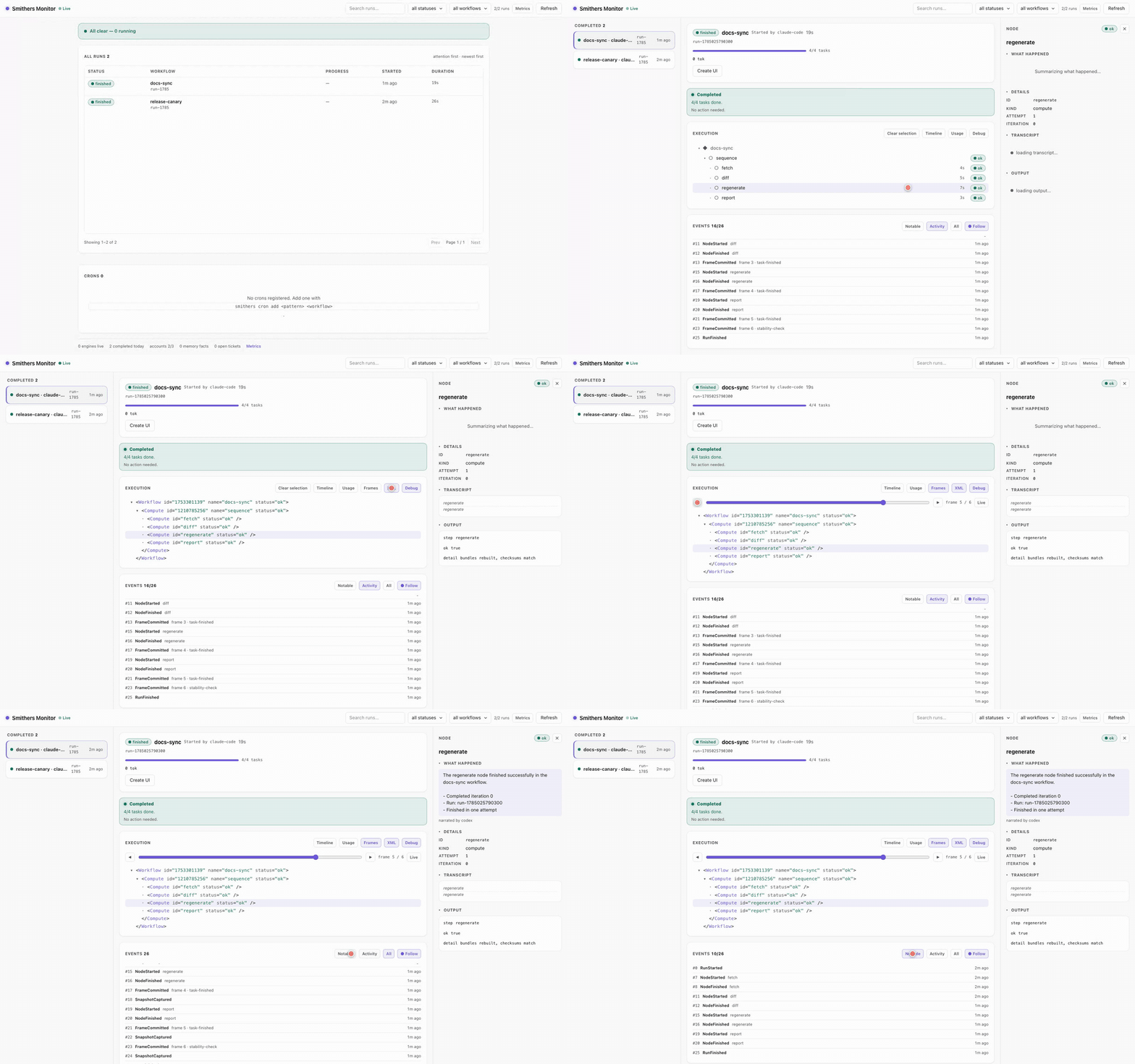 Marking is checkable: a new `authoring-side-effects` eval suite (70
fixture workflows plus handwritten cases and a harness) and a
`gradeSideEffectCompliance` scorer statically grade whether a workflow
marks and reverts its side effects.
See the external side effects section of the
[Task docs](/components/task) and the
[time-travel quickstart](/guides/time-travel-quickstart).
## Claude Opus 5 becomes the default implementer
If you use the shipped registry defaults rather than a custom
`agents.ts`, the model doing most of your work changed. SOTA registry v7
routes the `implement` and `smart` seats in CLI-generated agent pools to
Claude Opus 5; registry v6, also in this release, had already handed it
the orchestrator seat that Claude Opus 4.8 held. GPT-5.6 Sol and Terra
move to the review, validation, and checking seats.
```bash theme={"theme":{"light":"github-light","dark":"github-dark"}}
bunx smithers-orchestrator oneshot "make the flaky auth test deterministic"
```
* Cost scoring prices `claude-opus-5` at $5 per million input tokens and
$25 per million output tokens, the same as Opus 4.8.
* [`smithers oneshot`](/guides/oneshot) falls back in a new order: Claude
Opus 5, then Codex Sol, then Kimi K3, then Claude Fable 5.
See the [model selection guide](/guides/model-selection) for overriding
any seat.
## Point Opus 5 at your open issues
The new `opus5-bug-sweep` pack workflow applies the routing change:
Claude Opus 5 triages your open GitHub issues, fixes the straightforward
bugs in parallel jj worktrees, lands each fix through a serialized
compare-and-swap merge queue, gates the result with install, typecheck,
and lint in a scratch worktree, then pushes main and closes the issues.
It ships with a live UI.
```bash theme={"theme":{"light":"github-light","dark":"github-dark"}}
bunx smithers-orchestrator packs update
bunx smithers-orchestrator up opus5-bug-sweep
```
## Docs for humans, docs for agents
The docs site now separates its two audiences. The Product API tab is for
you: a [Platform Capabilities](/guide/capabilities) catalog of what you
can ask for in plain English, setup pages for each harness (Claude Code,
Codex, Cursor, Copilot, Pi, Hermes, OpenClaw), and a
[Set Up Semantic Memory](/guide/setup/semantic-memory) page covering
Hindsight and `HINDSIGHT_URL`. The Technical API tab is the agent-facing
reference, and its entry pages now say so.
## Other improvements
* **Every `@smithers-orchestrator/ui` component has a browsable
catalog:** 47 stories at
[storybook.smithers.sh](https://storybook.smithers.sh).
* **Launching Smithers from the Claude Code native Workflow tool no
longer crashes.** That tool's script sandbox defines no Node globals,
so the mirror script stopped referencing the bare `process` global.
## Upgrade notes
* **DB migrations 0031 (the side-effect journal) and 0032 (tool-call
tokens) run automatically** through the existing schema-migrations
runner the first time an upgraded CLI touches a workspace. No manual
steps.
* **`sideEffect` is opt-in.** A workflow that never sets it has no effect
boundaries, so rewind, fork, and replay behave exactly as before.
* **Shipped registry defaults now route the implement, smart, and
orchestrator seats to Claude Opus 5,** and `oneshot` prefers Opus 5
before Codex Sol, Kimi K3, and Claude Fable 5. A custom `agents.ts` is
unaffected.
## The full changelog
The complete commit-level history for this release is in
[CHANGELOG.md](https://github.com/smithersai/smithers/blob/main/CHANGELOG.md).
Found a bug? Run `bunx smithers-orchestrator bug` to file it.
Marking is checkable: a new `authoring-side-effects` eval suite (70
fixture workflows plus handwritten cases and a harness) and a
`gradeSideEffectCompliance` scorer statically grade whether a workflow
marks and reverts its side effects.
See the external side effects section of the
[Task docs](/components/task) and the
[time-travel quickstart](/guides/time-travel-quickstart).
## Claude Opus 5 becomes the default implementer
If you use the shipped registry defaults rather than a custom
`agents.ts`, the model doing most of your work changed. SOTA registry v7
routes the `implement` and `smart` seats in CLI-generated agent pools to
Claude Opus 5; registry v6, also in this release, had already handed it
the orchestrator seat that Claude Opus 4.8 held. GPT-5.6 Sol and Terra
move to the review, validation, and checking seats.
```bash theme={"theme":{"light":"github-light","dark":"github-dark"}}
bunx smithers-orchestrator oneshot "make the flaky auth test deterministic"
```
* Cost scoring prices `claude-opus-5` at $5 per million input tokens and
$25 per million output tokens, the same as Opus 4.8.
* [`smithers oneshot`](/guides/oneshot) falls back in a new order: Claude
Opus 5, then Codex Sol, then Kimi K3, then Claude Fable 5.
See the [model selection guide](/guides/model-selection) for overriding
any seat.
## Point Opus 5 at your open issues
The new `opus5-bug-sweep` pack workflow applies the routing change:
Claude Opus 5 triages your open GitHub issues, fixes the straightforward
bugs in parallel jj worktrees, lands each fix through a serialized
compare-and-swap merge queue, gates the result with install, typecheck,
and lint in a scratch worktree, then pushes main and closes the issues.
It ships with a live UI.
```bash theme={"theme":{"light":"github-light","dark":"github-dark"}}
bunx smithers-orchestrator packs update
bunx smithers-orchestrator up opus5-bug-sweep
```
## Docs for humans, docs for agents
The docs site now separates its two audiences. The Product API tab is for
you: a [Platform Capabilities](/guide/capabilities) catalog of what you
can ask for in plain English, setup pages for each harness (Claude Code,
Codex, Cursor, Copilot, Pi, Hermes, OpenClaw), and a
[Set Up Semantic Memory](/guide/setup/semantic-memory) page covering
Hindsight and `HINDSIGHT_URL`. The Technical API tab is the agent-facing
reference, and its entry pages now say so.
## Other improvements
* **Every `@smithers-orchestrator/ui` component has a browsable
catalog:** 47 stories at
[storybook.smithers.sh](https://storybook.smithers.sh).
* **Launching Smithers from the Claude Code native Workflow tool no
longer crashes.** That tool's script sandbox defines no Node globals,
so the mirror script stopped referencing the bare `process` global.
## Upgrade notes
* **DB migrations 0031 (the side-effect journal) and 0032 (tool-call
tokens) run automatically** through the existing schema-migrations
runner the first time an upgraded CLI touches a workspace. No manual
steps.
* **`sideEffect` is opt-in.** A workflow that never sets it has no effect
boundaries, so rewind, fork, and replay behave exactly as before.
* **Shipped registry defaults now route the implement, smart, and
orchestrator seats to Claude Opus 5,** and `oneshot` prefers Opus 5
before Codex Sol, Kimi K3, and Claude Fable 5. A custom `agents.ts` is
unaffected.
## The full changelog
The complete commit-level history for this release is in
[CHANGELOG.md](https://github.com/smithersai/smithers/blob/main/CHANGELOG.md).
Found a bug? Run `bunx smithers-orchestrator bug` to file it.